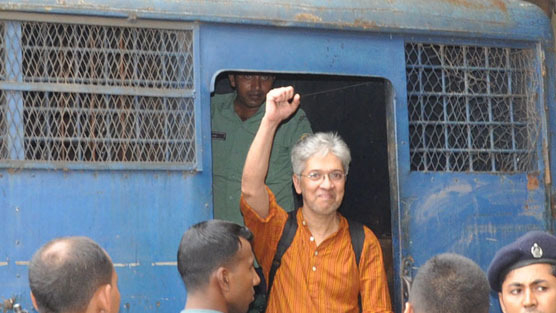
The Asia Democracy Network (ADN) would like to congratulate Mr. Adilur Rahman Khan on being awarded the 2014 Gwangju Prize for Human Rights.
Khan, a renown human rights defender known for his courage by the global human rights community, have been for many years been persecuted by the incumbent regime in Bangladesh.
A former Deputy Attorney General of Bangladesh, Adilur has been active in the promotion of human rights, democracy, and the rule of law, and in highlighting the extrajudicial killings and disappearances that vex Bangladesh. His association with Odhikar, a reputed national human rights organisation, as its Secretary, has placed Adilur on a persecution list prepared by the Bangladesh government. (AHRC)
Last year, for 62 days, from 10 August to 11 October, Adilur was detained by the government without warrant. The ostensible reason for persecution of Adilur and Odhikar is the publishing of a report that documents 61 extrajudicial executions undertaken by security forces during demonstrations against the incumbent regime. Odhikar has continued to face threat of forced closure. Its staff has been hounded and intimidated with threats of fabricated criminal charges. Yet, Adilur has continued his work, risking life and freedom. (AHRC)
Adilur has been awarded the 2014 Gwangju Prize for Human Rights, which he will share with Mothers of Khavaran from Iran. The award will be presented in a public function held in Gwangju, South Korea, on 18 May 2014. (AHRC)
The Gwangju Prize for Human Rights promotes the spirit of the May 18 Democratic Uprising, wherein the people of Gwangju, South Korea, resisted brutal military forces to help establish democracy and human rights in the country in 1980. The prize is awarded annually to an individual or organization that has struggled for or contributed to the improvement and advancement of human rights, democracy, and peace in their community and country. (AHRC)
ADN once again congratulates Mr. Khan and hope that this will bring more awareness to the struggles of defending human rights in Bangladesh.
Read full statement released by the Asia Human Rights Commission:
ASIA: Global recognition for persecuted Bangladeshi human rights defender
Former Laureates of the Gwangju Prize for Human Rights:

Xanana Gusmão – Timor Leste (2000)
Born in Manatuto, East Timor on June 20, 1946, Xanana Gusmão was sentenced to life imprisonment for his involvement in the armed Timorese resistance following Indonesia’s invasion and occupation of East Timor in 1975. Gusmão continued organizing various Timorese independence movements from prison. Following the fall of the Suharto regime in Indonesia in 1998 and Indonesia’s subsequent withdrawal from East Timor, Xanana Gusmão became the first President of a newly independent Timor Leste in 2002.

W.P.J Basil Fernando – Sri-Lanka (2001)
The Asian Human Rights Commission (AHRC) was founded in Hong Kong in 1986 by a group of jurists and human rights activists and organizations in Asia. Basil Fernando has been the Executive Director of the AHRC since 1994. Under his leadership, AHRC played a major role in the enactment of the ‘Asia Human Rights Declaration’ along with 30 leaders of Asian human rights organizations in Gwangju in May 1998, putting Gwangju on the map of human rights.

Korea Association of Bereaved Families for Democracy – Republic of Korea (2002)
In December 1999, thanks largely to a year of campaigning by KABFD, the Korean National Assembly enacted the ‘Act in Restoration and Compensation of Democratic Activists’ and the ‘Special Act to Find the Truth in Cases of Suspicious Deaths’. These acts contributed to restoring the honor of those who sacrificed themselves in the fight for democracy, highlighted the historical significance of the pro-democracy movement and helped to launch subsequent investigations into other instances of state violence in Korean history.

Dandeniya Jayanthi – Sri-Lanka (2003)
Dandeniya Jayanthi was born in rural Sri Lanka in 1959 and later worked in a Free Trade Zone with her fiancé Ranjith, who was abducted and disappeared, one of many tens of thousands of disappearances in Sri Lanka’s long civil war. With support from the Asian Human Rights Commission and the May 18 Memorial Foundation, Jayanthi was able to build a Monument for the Disappeared including Ranjith which was declared open on 4th February 2000, Sri Lankan Independence Day. Now an annual event where both Singhalese and Tamil victims of the civil war can participate, the memorial ceremony has become a catalyst for taking action on human rights violations in Sri Lanka.

Aung San Suu Kyi – Burma (2004)
Aung San Suu Kyi became a national leader through her consistent and brave struggle against the merciless suppression of the democracy movement in 1988. The daughter of Aung San, the leader of Burma’s independence movement and Khin Kyi a nurse at Rangoon General Hospital (later appointed Burmese ambassador to India), Daw Suu Kyi has consistently adhered to a path of nonviolence while facing one of the must inhumane regimes in the world. For her efforts she was awarded for the Nobel Peace Prize in 1991.

Wardah Hafiz – Indonesia (2005)
Wardah Hafiz was born in Jombang, East Java 1952. Alongside her outstanding activities in the areas of fighting urban poverty and promoting women’s rights, Wardah Hafiz was also one of the leaders of the pro-democracy movement in Indonesia, and helped in bringing an end to dictatorial government rule. She played a major role in preventing the military regime in Indonesia from once again seizing power by investigating and exposing the corruption amongst high level families in the first free elections following the demolition of the Suharto regime.

Angkhana Neelapaijit – Thailand (2006, Co-laureate)
Angkhana Neelapaijit’s husband Somchai Neelapaijit, a prominent lawyer and human rights defender in Thailand, disappeared on 12 March 2004. At the time of his disappearance Somchai Neelapaijit was acting on behalf of five individuals detained in connection with the violence in the deep south of Thailand. Since that time Angkhana Neelapaijit has stood firmly on the front lines to obtain justice regarding her husband’s disappearance. In March 2006, Angkhana received an award from the National Human Rights Commission of Thailand to mark International Women’s Day and has become an inspiration for many in her society and beyond.

Malalai Joya – Afghanistan (2006, Co-laureate)
Malalai Joya was born in 1978 in Farah, Afghanistan. At the age of 24 she was elected representative of Farah Province after the collapse of Taliban rule and in 2005 was elected to the 249-seat National Assembly or Wolesi Jirga. As a result of her speaking out publicly against human rights violations and on issues affecting women in Afghanistan, Joya has received numerous death threats and survived four assassination attempts. In the face of these challenges she refused to back down or remain silent saying ‘They will kill me but they will not kill my voice, because it will be the voice of Afghan women. You can cut the flower, but you cannot stop the coming of spring.”

Irom Sharmila Chanu – India (2007, Co-laureate)
Irom Sharmila Chanu (born March 14, 1972), also known as the “Iron Lady of Manipur” is a civil rights activist, political activist, and poet from the Indian state of Manipur. On 2 November 2000 the Indian military opened fire on its own citizens in Manipur. Sharmila has since been on hunger strike to demand that the Indian government repeal the Armed Forces (Special Powers) Act, 1958(AFSPA) and is thus known as the world’s longest hunger striker. She was named the “Iron Lady of Manipur” by the People’s Rights Organization on International Women’s Day 2005. Currently she is in custody at J.N. Hospital, Manipur.

Lenin Raguvanshi – India (2007, Co-laureate)
Lenin Raguvanshi, was born into an upper-caste Hindu family in Varanasi, India. Lenin and his wife Shruti came face to face with the reality in India’s villages where the Dalit households live a humiliating existence subjected to the most inhuman treatment by the upper castes and face atrocious treatment from the police and upper-caste gangster elements in connivance with corrupt politicians and administrative officials as a result of caste-based discrimination. The realization that only awareness, education and unity could lift them out of this cycle led Lenin to found the People’s Vigilance Committee on Human Rights or PVCHR in May, 1995.

Munir Malik – Pakistan (2008)
Munir Malik, a Pakistani lawyer born on April 8 1950, as General Secretary of the Karachi Bar Association was one of the leaders of the movement for the restoration of democracy fighting against the dictatorship of General Zia-ul-Haq. During the rule of General Pervez Musharraf in 2006 Malik was elected President of the Supreme Court Bar Association of Pakistan and was one of the leaders of the lawyers’ movement for the reinstatement of the Chief Justice of Pakistan, representing the Chief Justice when charges were brought against him.

Min Ko Naing – Burma (2009)
Min Ko Naing was born Paw U Tun in 1962 in Burma (“Min Ko Naing” means “Conqueror of Kings”). He played a prominent role in the 1988 uprising where Burmese people took to the streets marching in protest against the military junta and is one of the most well known and outspoken opponents of the military regime in Burma despite being imprisoned for most of the period 1989-2012. In 1988 he said “I will never die. Physically I may be dead, but many more Min Ko Naings will appear to take my place.” Along with other Burmese political prisoners he was released in January, 2012.

Sushil Pyakurel – Nepal (2010)
Sushil Pyakurel is a former Commission of Nepal’s National Human Rights Commission (NHRC). In 1984, Pyakurel founded the Forum for the Protection of Human Rights, the first human rights organization in Nepal. In the 2000s Pyakurel made several significant, and on occasion, controversial contributions to the field of human rights during the conflict in Nepal. Most notably he boldy criticized the King of Nepal’s decision to assume executive power on 1stFebruary2005. Since the peace agreement of November 2006, Pyakurel has been actively engaged in Nepal’s ongoing political process.

Binayak Sen – India (2011)
In the words of the Free Binayak Sen campaign, ‘Mandela was jailed by racists, Suu Kyi by dictators and Binayak Sen by the world’s largest democracy.’ Binayak Sen is an Indian pediatrician who has devoted his life to the health of the marginalized adivasi tribal people in India. Sen’s imprisonment on a life sentence after he documented human rights abuses occurring in the anti-Naxalite conflict was widely protested as unjust including by 45 Nobel Laureates. Amnesty International declared him a ‘prisoner of conscience.’ Sen was released on bail on 18 April 2011, only several days before being awarded the 2011 Gwangju Prize for Human Rights.

Laureate of the special prize for the Gwangju Prize for Human Rights (2011)
The Parents Circle Families Forum – Israeli Palestinian Bereaved Families for Peace – Israel, Palestine
The Parent’s Circle Families Forum – Israeli-Palestinian Bereaved Families for Peace is an organization made up of over 500 bereaved families, Israeli and Palestinian. Since 1994, the members of this organization, all of whom have lost a family member to the conflict, have undertaken a joint effort in the midst of ongoing violence to transform their incredible loss and pain into a catalyst for reconciliation and peace.
